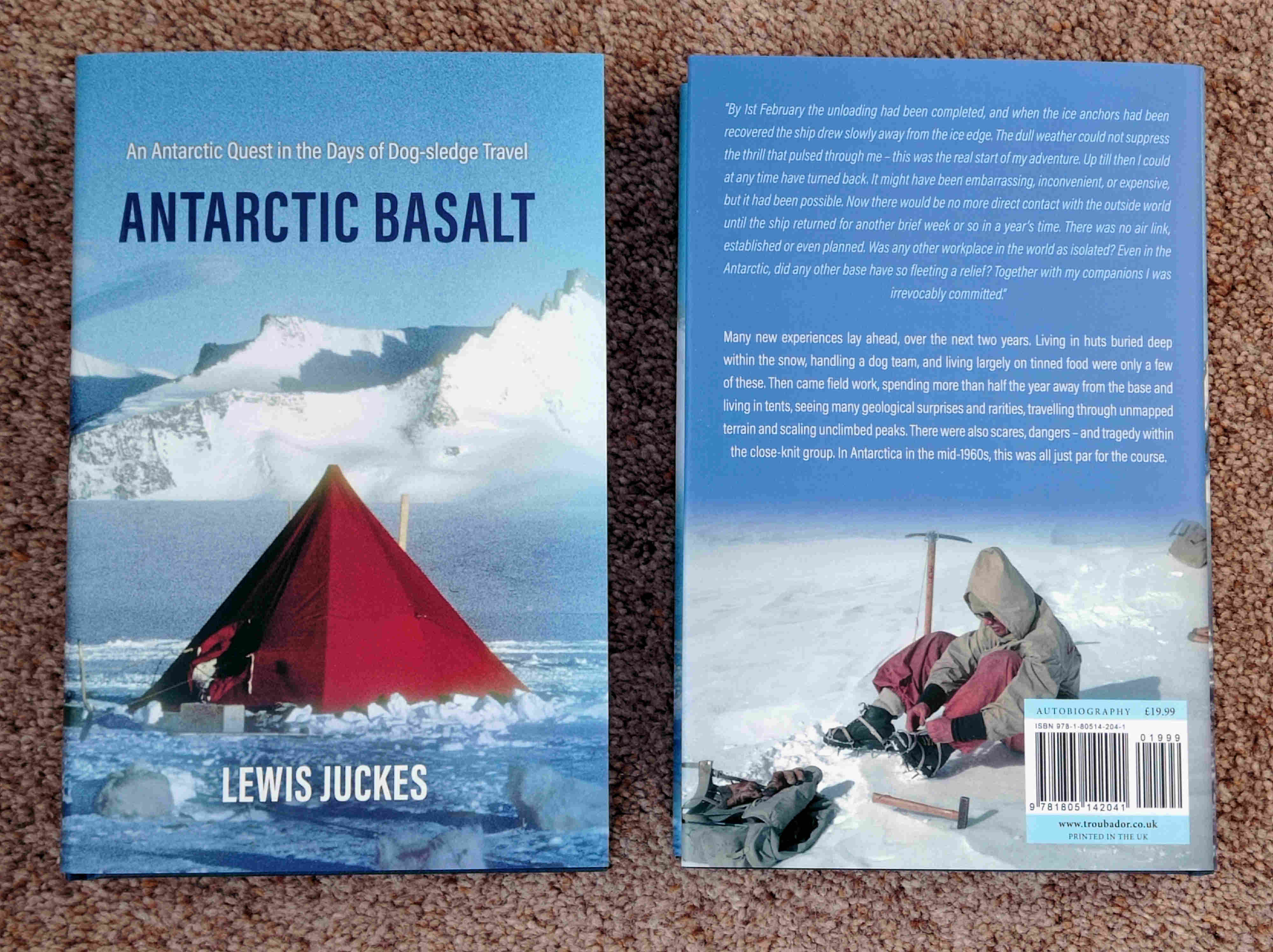
The book is made of three distinct threads. The main one is the life at the British Antarctic Survey's (BAS) base at Halley Bay in the mid-1960s, and the fieldwork carried out from there in the summers. Here I’ve tried to give an impression of as wide a variety of our activities and facilities as I could. This will certainly give the reader a good idea of how we lived, but it should not be seen as “how things were” generally in the Antarctic in those days. Even amongst the British bases there were major differences; for instance, at the other locations the huts were built on rock rather than ice, and in some cases were on islands which could restrict travel when the sea ice melted. Those other bases were also smaller, and in lower latitudes.
The second thread is geological. Nowadays even schoolchildren learn about Plate Tectonics; in the years described here the equivalent theory of Continental Drift was only supported by a minority in the geological world. In fact, as can still be seen in books of the time, it was often regarded not as a theory to be debated by scientists but as nonsense in the same category as the Flat Earth. Thus to many serious geologists it was not worth mentioning, let alone debating. In that global setting, I found myself studying under a Professor who not only supported the idea of Continental Drift but published extensively on the subject. In one paper he noted that the location where we then were, on the eastern coast of South Africa, would once have adjoined an unexplored region of Antarctica and so he declared that its likely geology could be predicted. The discovery there of the predicted lavas of basaltic composition and Jurassic age would provide a substantial boost to his arguments. At that time, BAS was about to send field parties to that region, and he was able to arrange for one of his graduates to be included. That was how I came to be there, hoping that I would be the one to discover the basalt.
The third thread is my own story. Although I try to use this to illustrate the different aspects of our life there, inevitably it follows what I did and where I went. Here I was fortunate in that my job gave me experience of life both in the huts and the field. The way in which I interpret and describe some events will be led by my own views and experiences, but I’ll leave the reader to judge where that takes things.
Very nearly a quarter of a century after I began, my book has been published! In the mid-1960s, more than half a lifetime ago, I spent two years in the Antarctic in days when life was so different that younger generations now find it hard to picture. There were events that even then were noteworthy; now, as those of us in our eighties or beyond leave the stage in turn, many such tales are being lost forever. I must admit that I was thinking largely of my own family, but I wanted to preserve some first-hand accounts for them.
I began writing in the year 2000, when I retired from my job in the steel industry. My first thought was to write things down in as much detail as I could. This was already more than thirty years after the events down south, and I was conscious that memory can not only fade or distort, but that the faulty portions can seem very convincing. Thus much of my time went into finding references, starting with my own diaries, notes, letters, photos and other sources. The next step was to ask old comrades what they had, either in memories or in more tangible form.
The search continued to widen, and I turned to the reports that we wrote for BAS while we were down there. These seemed such a bind at the time but now they can be seen as a fantastic source of information – even if much of it is written in such a way that can only be fully understood by someone else who was there at the time, or at least has a very good knowledge of that period. I began to order copies, and before long I had filled half a dozen box-files with photocopies. (I gather that nowadays one gets copies as PDF files, but by then I already had all I wanted.)
As I closed in on the end, I began to think of publishing a version and realised that what I had before me was far too long. I began cutting it down from the original size of nearly half a million words, and after several sweeps through it the word-count was down to a mere 130,000.
That was when I began to try to find an agent – the current wisdom is that it is better to start by approaching agents than going straight to publishers. This was a slow process, generating a pitch for each one. All had different requirements; some wanted a one-page precis; others a two-page list of chapter summaries; and for examples of the text some specified the first 10,000 words while others wanted the first chapter and any chosen one. A few wanted an analysis of comparable books already on the market, and one introduced me to a new meaning for a familiar word. To me, “blurb” meant simply any publicity or advertising text. Now I learnt that in the publishing industry it’s specifically the wording that appears on the back of the cover or dust jacket of a book.
This process drifted on over a couple of years, and during that time I saw several old comrades pass away and one or two others lapse into dementia so that they would never appreciate it when it did come out. Thus I decided that it was time to get things moving, even if it meant paying for it. Around this time, I saw the book Tales from Bluebell Cottage by Brian (“Tal”) Taylor, describing his time at Fossil Bluff. (“Bluebell Cottage” was the name given to the hut at Fossil Bluff.) He had had that done by Troubador Publishing, so I approached them and before long we had reached an agreement.
This put me into another search. I had always thought that such an eventual book would need photographs but told myself that I had plenty to choose from in my slide collection. Now, with deadlines being set up, I needed to gather the candidate shots promptly. A look through my slides reminded me that not all those 35mm colour slides had been digitised yet, and there were some essential aspects of our life back then which were not in the collection. Thus I approached several comrades from those years to see if they could provide any winning shots that I had missed.
This brought plenty of offers, but it also increased my selection dilemma. I wanted the photos on shiny paper, and this meant separate Plate Sections amongst the pages of text. The number of pages in these would be multiples of eight, and with two per page that meant I had to choose photos to a number that was a multiple of sixteen. I chose 32, and after trying to cut down to this I felt that I had to raise it to 48. Then another round of comparing and choosing, but at last I got the list down to that number.

Maps were an easier topic, as I’d been looking into this from almost the start. Two things had come together, back then. First, with several polar books that I read I found myself wishing that they had maps showing in detail where the action had taken place, and with all the text at a legible size. Not long after, I saw a book on a trip through the Pacific islands in a sailing boat, and that one had beautifully clear maps. That, I decided, was the kind of thing I wanted for my memoirs and for any book that might arise from them. They had to be maps specifically for the book and showing all the places mentioned in the story, rather than maps drawn for some other purpose by some institution and that had simply been shrunk down to book-page size.
Getting them prepared commercially seemed the obvious thing, until I looked into it. Apart from the price (and that was substantial), there could be complications with ownership of copyright. Say I later wanted to write an article for a magazine, those maps might not be free for me to reuse. Equally awkward was the question of how easily I could get changes made later on, even small ones. The pricing system niggled me too; it seemed that if I had one map, but two versions of it so that each showed a different sledge track, I would be charged the full price for preparing two maps.
An internet search was needed, to see whether I could do the job myself. This brought up Inkscape, a free drawing program, so I installed it on my trusty home-built PC. At first I was completely baffled by it but, as always, there are plenty of tutorials on YouTube, and forums to be found on Google. Before long I was turning out maps slowly, and then more easily. At later stages, when I found that changes were needed, it was simple to apply them. In one or two cases I shrank individual maps to show the surrounding area or expanded them to show more detail, and at a late stage I went through every one of them, enlarging the fonts after I realised how much smaller a printed page would be than my editing screen. I shudder to think of the complications of getting all that done commercially!

Those were the components of the book itself, and soon they were chugging their way through the system. That didn’t mean that things eased up, though. Proofreading and choosing details for the dust jacket followed, and then decisions on whether to have eBook and audiobook versions. In fact, both of those are now available.
But central to it all, the good old-fashioned book on paper pages is now available. Inside are a total of 436 pages, including 21 maps and 4 diagrams (of the huts), plus 48 photographs. There’s an index filling 13 pages. And now, you too could own a copy! The link below will get you to the Troubador website.
For addresses within the UK, you can buy it directly from me. There’s a discount bringing the price down from the recommended £19.99 to £18 – and on top of that, no charge for post and packing within the UK.
(Purchases can probably be sent to other countries if necessary, but postage costs would have to be included and could easily equal or exceed the cost of the book itself.)
No fancy payment page, I’m afraid – I’m writing all these pages with fairly simple coding, and a page for handling money securely is far beyond my capability. Instead, then, please send an email to the disguised email address below. (In this sad world of ours, a disguise is needed to hide the address from the robotic searches of the spam merchants and worse.) The only payment method at present is by Bank Transfer.
So, you’ll have to copy this address:
contact3@lewis8juckes4.co.uk
Paste it into your email package and then delete the numerals to remove the disguise. Send off your order or query and I’ll let you know how to continue.
Alternatively, a click on the green button below will take you to the website of Troubador, the publisher.
