When I sailed for the Antarctic I had with me a cine camera, and during my two years down south I took several reels of film. It took standard 8 mm film, a product which had been developed as a cheaper way for amateurs to use the widely available 16 mm film. In fact, 8 mm film was 16 mm film, but with extra sprocket holes along the edge. As it ran through the camera, it was only one half of the film that was exposed. When the spool came to the end, the user reversed it by moving the now-full take-up spool to the top, and moving the empty spool down to the take-up position. It now ran through again, with the other half being exposed and the film ending up back on its original spool. We had to send that back to the manufacturer for it to be developed, and they then split it down the middle and connected the two lengths end to end. Thus what one got back was now 8 mm wide.
This was not ideal; originally, the size of the sprocket holes had been chosen to match the whole width of the film strip being exposed. With the strip halved, the sprocket holes took up a disappointingly large proportion of the width of the strip. Quality was rarely good, enlarging up from such a tiny frame – but for amateurs at the time, it was the only economical option. (That’s my excuse in advance, for the appearance of parts of my film!)
Strictly speaking, there was another option that offered better use of the film area, and that was 9.5 mm. With the sprocket holes between the frames rather than along the edges, there was a much more effective use of the film width. However, although this format had been around for decades it had not really taken off and 8 mm dominated the amateur market. I cannot remember ever seeing a 9.5 mm cine camera.
A few years later a more efficient 8 mm format was developed from scratch, called Super 8 (and the closely-related Single 8) – but too late for me!
So, on to the filming. I took some on the ship heading south, a bit more in South Georgia, and then some at Halley Bay during the remains of summer after our arrival. Then, with the arrival of winter, I decided that it was time to start filming indoors. For this I had a movie light, looking rather like a tractor headlight on a handle, but then there was the film to consider.
Colour film was optimised for a certain colour temperature, either type D for daylight or type A for artificial light, and they were not directly interchangeable. If type D was used with electric lighting the colours in the film had a yellow or orange cast, while using type A in sunlight gave pictures with a harsh blue appearance. They were not completely incompatible, as filters were available for conversion in either direction. The problem was that going from D to A lowered the film speed. In the case of the widely-used Kodachrome II this dropped it from 25 ASA to a barely-usable 10. Using the correct film in each case was by far the best ploy – if one had thought ahead, and bought some in advance.
Getting the camera out and capturing some film could be inconvenient (especially if one was supposed to be part of the work party being filmed) and so when I did get the camera out I would try to film as much in that session as possible. This was more so indoors, for a variety of reasons. For a start, one needed an electric socket for the light, and in those days one was lucky if the room involved had even one of those.
Mechanically, the whole filming process was clumsy and precarious with the camera on my rather flimsy tripod and the power cable for the light snaking across the floor. Ideally one needed an assistant to help and in particular to watch the cable, and I was lucky here because Mike Turner also had a movie camera. Thus we could set things up for a joint filming session, leaving each operator in his turn free to devote his full attention to capturing the scene.
In one session we began in the kitchen, where Andy Champness tried gallantly not to show that the powerful light was dazzling him. Next was the new hut, and with some sections advancing faster than others there was a whole range of photogenic activities on the go. Our last call was the garage, where Jock Thomson tripped over the cable, brought down the light, and put an end to our activities until we could make some repairs.
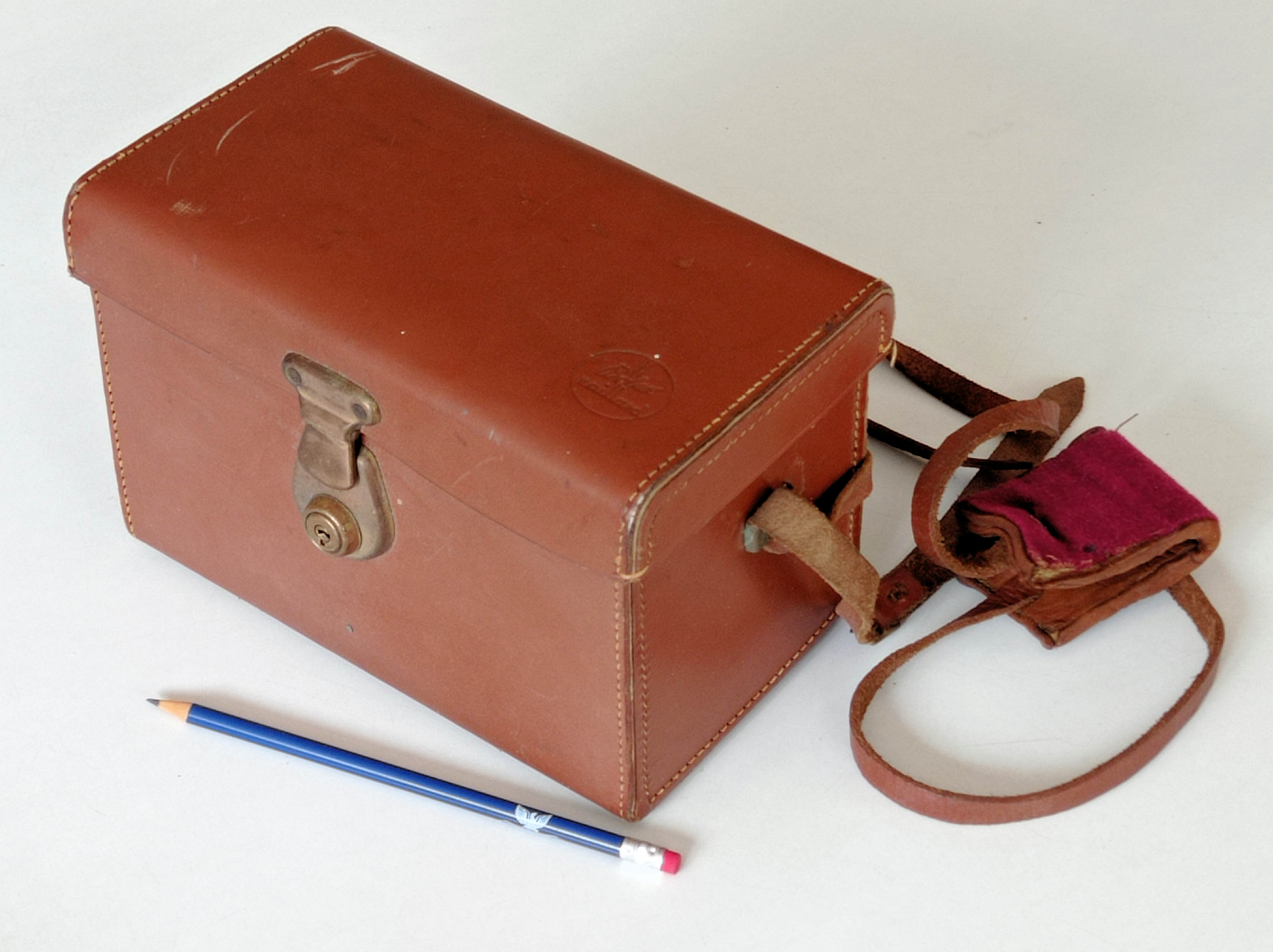
At this time of year we were preparing to go into the field for the summer. Gordon Bowra, who had spent the previous summer in the mountains, advised me that my cine camera would be too large and awkward to take sledging. It was a Bolex H8, top of the 8 mm range but large and heavy (people often mistook it for a 16 mm camera). Thus he suggested that I swap it for his much smaller Bolex D8. That came in a compact but sturdy case, with a pistol grip for easy filming when a tripod was not available or convenient, and so trading seemed an excellent idea. (There was also a cash adjustment, and I was surprised to find how unfamiliar, and almost pointless, money seemed in the world where we lived at the time.)
It may be worth mentioning that neither of these cameras had a zoom lens. The complexity of designing zoom lenses with good image quality meant that they didn’t become widely available (for cine or 35 mm cameras) until computers could be used for the necessary calculations. Our cine cameras had turrets on the front, so that one could rotate it and switch from, say, a standard lens to a wide-angle version in a moment.
One then had to remember to make the same switch with the viewfinder, to frame the scene correctly! This was a separate optical system, effectively a crude and low-power telescope beside the main optical system, mounted either inside the casing or attached to the outside. In this case a zoom lens could be used, as the image quality needed was not high. Thus one simply turned a knob to the number matching the lens that had been selected.
Both of these cameras were powered by clockwork motors, and so the length of any one scene was restricted by the power of the spring. The biggest difference between the two models was that the H8 could take 100-foot spools of film, while the largest that would fit in the D8 were 25 feet.

Finally, exposure in that era had to be set manually. We did have light meters to indicate the best setting, and the D8 had a knob that one could press (while the camera was not running) so that a tiny light meter element swung out behind the lens and took a reading there. This was more advanced than most of our 35 mm cameras at the time, where the first models with behind-the-lens light meters were only just becoming available.
Many years later when I had the film reels digitised, I phoned the fellow doing it to check on progress. He seemed a bit shocked by one sequence: “Did you know there’s footage of a polar bear being skinned?”, he asked me.
Not quite, but the details came back to me. Towards the end of the 1964 winter Barney, one of our dogs and yellowish-white in colour, died. Gordon Bowra, our doctor, performed a post-mortem down in the workshop. As Barney had been in the team that I would be using, and two of his brothers were still there, I was paying attention. Normally I would have been too squeamish to watch something of that sort but with my cine camera and light only just back in operation after repairs I felt that such an event was just asking to be recorded. And also, there was probably an effect of boredom after the long indoor winter, leading me to clutch at some novelty when it appeared.
This had consequences that I only learnt some years later. In those days cine film was posted back to the manufacturer who processed it and returned it by post. For a return address I put that of my parents. Many months later, after the next ship had taken our mail north and the film had been processed, it reached them in South Africa. Few people had cine projectors and so they located a family in the neighbourhood who had one, and approached them. They were keen to see these images from such a far-off place and so they agreed eagerly. The evening was made into quite an event, with one or two other families invited along and the children there for the penguins that would surely feature. Then they put in the first, randomly-selected, reel and found themselves facing several very gory minutes. My judgment came in for severe questioning.
But, the rest of it brought back some wonderful memories for me when I looked through all the reels. Much was repetitive or simply hadn’t come out well, so there was plenty of editing to do. That had to wait until I had a decent video editing package on my computer, but at last I got it sorted out. And, I can assure you that this edited version does not include any of the post-mortem (though it does contain scenes of cutting up frozen seals for dog food). I hope you enjoy the result!
Depending on your browser, you should be able to click on the picture below to run the video. Note that it starts with the volume muted. As with any video from the internet, it can be easier on the ear to bring in the sound by moving the volume slider up from its starting position at zero, rather than simply unmuting by clicking on the “loudspeaker” icon.
